FARMHOUSE
FARMHOUSE POTTERY STUDIO
Portfolio
Artist W. Ellen Williams
W. Ellen Williams is a Ceramic Artist working in woodfired, salt-glazed stoneware.
ARTIST STATEMENT
As a multidisciplinary artist, my practice brings together classical techniques and contemporary expression, with clay at the heart of the journey.
Exploring a range of creative mediums, my work remains deeply rooted in immersive studio practice, where process, material, and transformation play central roles.
My ceramics work emphasizes the authenticity and simplicity of clay, exploring ways that this humble material, transmuted by the fire, can carry both aesthetic depth and emotional resonance. Each piece is created with a focus on function and connection, inviting audiences into moments of stillness and introspection.
Recent projects extend this exploration, delving into themes of time and inner transformation. These works move beyond traditional boundaries to encourage viewers to engage with past and present in a profound and personal way.
SELECTED WORKS
Woodfired vessels with slip and salt-glaze surfaces
ABOUT THE ARTIST
"Each work emerges through process — shaped and prepared for resolution through firing."
W. Ellen Williams is a ceramic artist based in coastal Victoria, her studio located on a picturesque farm property near to the township of Inverloch.
With a background in formal education and over two decades of teaching experience, her creative and teaching practice emphasise craftsmanship as the foundation of innovation and expression.
Now focused primarily in woodfired, salt-glazed stoneware, her works are influenced by artisanal tradition and process-led practice, reflecting a commitment to material restraint and a considered refinement of form.
Form & Making
Work is progressively developed on the wheel through a process of repetition, with forms made in series rather than as isolated pieces. This allows proportion, volume, and function to be tested and adjusted over time.
Attention is given to the relationship between scale, weight, and balance — particularly in larger forms such as pitchers and jars, where this relationship must support both use and presence.
Alteration is introduced at freshly thrown, or a soft leather-hard stage, where rims are pulled and spouts set with throats adjusted to resolve line and direct the movement of liquid within the form.
At leatherhard, forms are trimmed in a chuck, then handles and attachments are made and applied with consideration to both function and integration, avoiding the appearance of separate elements.
Materials
A high-fired stoneware body is developed, with materials selected for durability and responsiveness in both forming and firing. The clay is suited to extended firings and capable of carrying the effects of ash and vapour glazing without loss of structure.
Surfaces are chattered, fluted, or left largely unadorned. Where flashing slips or simple shino and celadon glaze layers are used, they are applied sparingly, allowing the clay body, salt and firing conditions to play a primary role in surface development.
Variation in surface is achieved not through applied decoration, but through the interaction of material, placement, and atmosphere within the kiln.
Firing
Work is fired in an 80 cu ft Twin Bourry Woodfired Kiln using Salt-Glaze methods, in extended firings where temperature, atmosphere, and ash deposition are allowed to interact directly with the clay surface.
The kiln is brought steadily to temperature, alternating stoking cycles between the Bourry Boxes to influence flame path and atmosphere. Reduction and oxidation atmoshere are managed throughout the firing, contributing to variation in surface and tone.
Salt is introduced as the kiln is approaching peak temperature, producing a vapour glaze that bonds with the silica in the clay body.
Placement within the kiln is considered carefully, with each piece responding differently depending on its location and relationship to other work. The resulting surface varies according to form, exposure to flame, and duration of firing.
Outcomes cannot be fully controlled or repeated, and each firing contributes to an ongoing understanding of the process.
"My work does not aim for uniformity, but for resolution — where form, material, and surface are brought into balance through making and firing processes."
A POTTER'S JOURNEY
Every Potter's Journey begins with inspiration...
...and this work is dedicated first to my mother, Nellie, who always supported my creativity, and second, to the ceramic artists of the past 100 years or so, who helped shape studio ceramics as we know it today.
My own Potter’s Journey began in the early 1980s.
While studying painting at art college, I took a ceramics class for the first time — and something immediately shifted.
Working directly with clay, learning to centre on the wheel, glazing and firing work changed how I understood making. It wasn’t instant or easy — centering was challenging for me — but eventually it clicked.
On my 21st Birthday, my parents gave me a wheel for me to pursue my Ceramics studies. That was the moment clay became part of who I am.
At that time, learning ceramics looked very different. There were no online videos, few accessible resources, and information came slowly — through second-hand, highly technical reference volumes by Leach and Rhodes (overwhelming for a young student, but which I still use today) and some old B&W Pottery magazines — as well as studio experimentation.
Eventually, towards the end of my studies, newer publications like Craft Arts became my creative touchstones. My wonderful mother began collecting these resources for this penniless student and they remain a source of inspiration to this day.
After graduating, I established my own modest studio with small gas kiln, however, as the handmade crafts went through periods of decline and change via mass commercial imports and the recession, I eventually moved into teaching, where I continued for 25 years.
Today, I am again creating in my new Farmhouse pottery studio, working from that same, faithful old wheel — having established a larger studio and, since building a Woodfired Kiln from which I now produce both functional and artisanal wares, I am finally fulfilling that dream from my college days long ago.
SHARING A LEGACY
My early experience of learning was shaped by access — or rather, the lack of it. What was possible came through persistence, resourcefulness, and the quiet support of those who recognised the value of learning a craft.
That experience has remained central to both my studio practice and my approach to teaching.
The Clay Studio Masterclass was developed in response to a gap I encountered over time — as both a student and an educator — where structured, process-led learning for developing a sustained studio practice was often absent.
The Program reflects the same principles that underpin my own work: repetition, discipline of form, and the refinement of process over time.
For those who wish to engage more deeply, the Masterclass and Companion offers a structured path and ongoing framework, supporting the development of skill, material understanding, and independent practice.
The 'Clay Studio Masterclass' is created for New and Returning Potters to get back into the Studio with confidence.
I hope this Masterclass will become a valued and accessible resource for your own Potter's Journey,
W. Ellen Williams
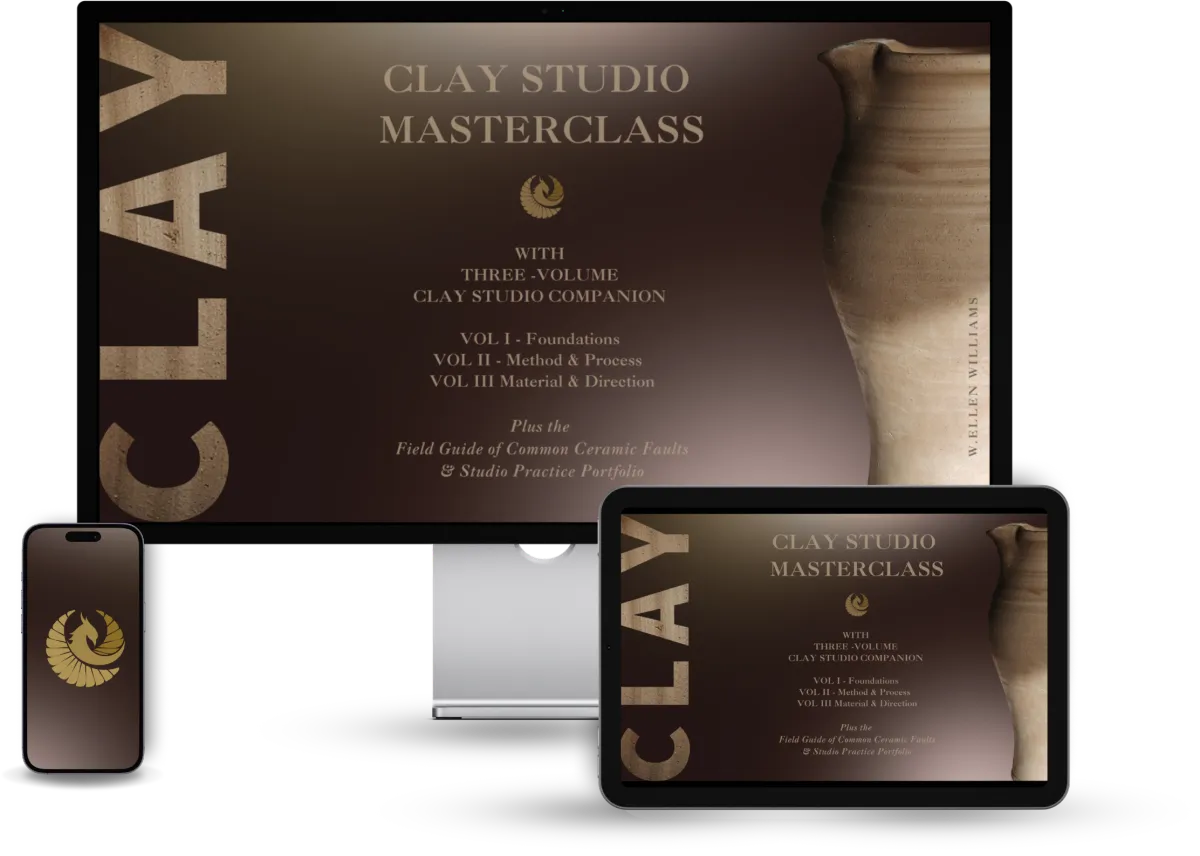
Clay Studio Masterclass
Developed from over 25 years of teaching and 40 years of studio practice, for those developing their own studio practice, a structured, studio-based learning system integrating workshop instruction with a companion text is available.
WHAT IS INCLUDED
- Full Clay Studio Masterclass workshop series
- Clay Studio Companion (digital edition, fully searchable)
- Integrated studio exercises, references, and technical guidance
- Direct linkage between written material and practical application
- Current program content and all future updates
ACCESS
Delivered as a fully digital program, designed to be used within your own studio environment, at your own pace.
$439 AUD
Designed for long-term studio practice.
FROM THE STUDIO
Subscribe for News and latest Events. Follow us on Social.


Subscribe to our Mailing List
Keep tabs on the next Kiln Opening. Learn More about the Masterclass Program.
FARMHOUSE
INFORMATION
LEGAL
© 2026 FARMHOUSE. All rights reserved.